TECHNOLOGY

How the automation works

AlgoSilicon's products are not hand-written once and frozen - they are emitted by an AI-driven design flow that turns an algorithm into verified hardware through three strictly-equivalent layers, then closes timing automatically. The flow is the moat; the IP catalog is its proof.

T1

Three-layer equivalence

Layer 1 - Golden model. A pure-Python statement of the algorithm, validated against the governing standard, reference toolboxes (e.g. MATLAB 5G Toolbox), or the published paper. It answers one question: what does this algorithm compute?

Layer 2 - Cycle-accurate model. A clock-true Python model of the chosen hardware architecture, validated bit-exact against Layer 1. Every register, every saturation, every pipeline stage - this model is the source of hardware truth.

Layer 3 - RTL. SystemVerilog emitted from the cycle model and verified against it with zero least-significant-bit tolerance, in both open-source and vendor simulators. Optimization loops modify the model first, then re-emit - the RTL is never hand-patched.
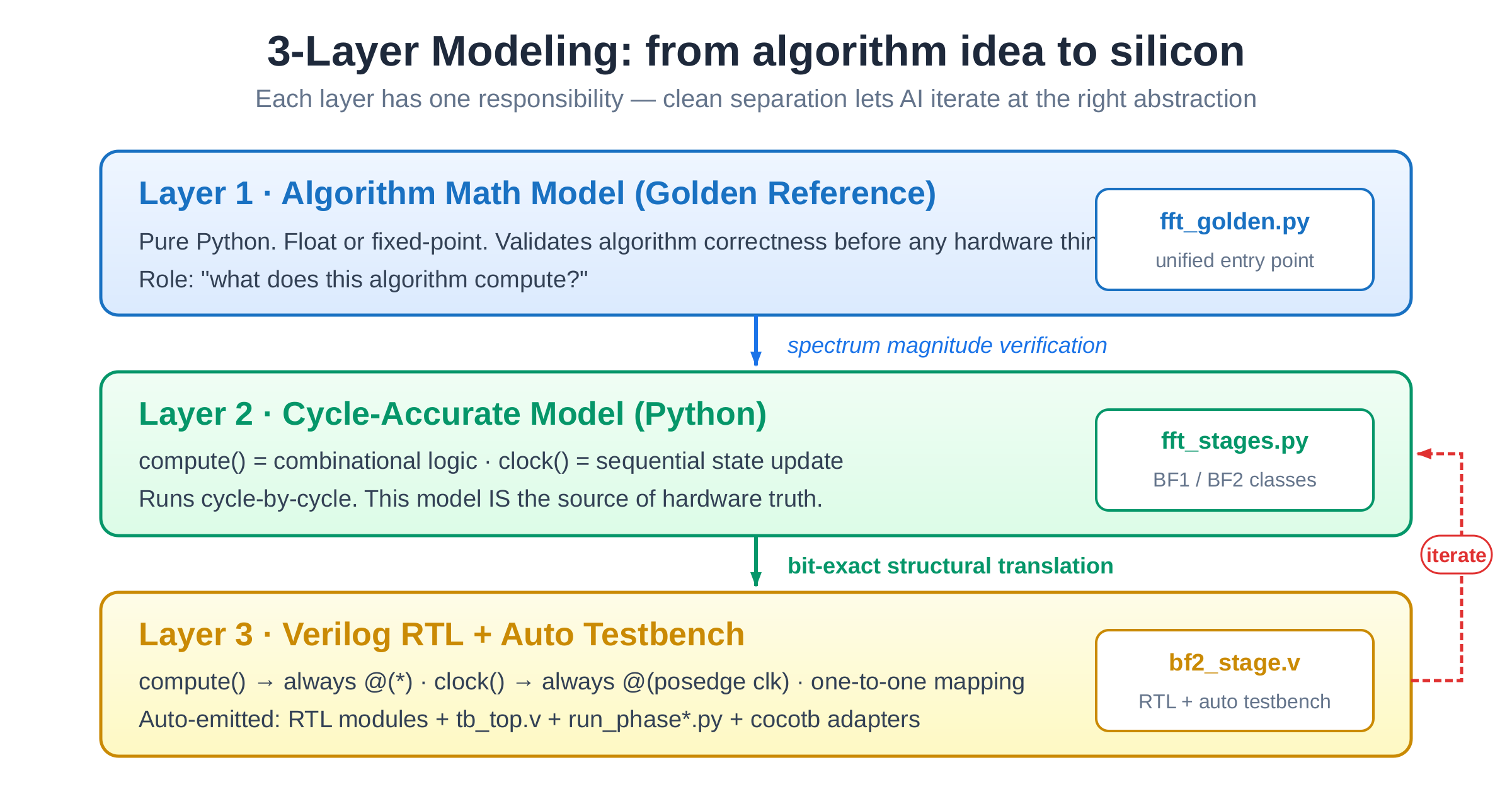
Three-layer modeling diagram
T2

Parameterized generators, not snowflake designs

A core family is captured once as a generator: architecture, schedule, bit-widths, and memory mapping all derive from the code parameters. New configuration, new standard variant, new device - regenerate, re-verify, deliver. This is how 20 5G NR decoder configurations were implemented end to end, with 19 matching or beating a commercial IP's clock. MEASURED

Right block, first time

Every operation is mapped to the silicon that wants it: multiplies to DSP slices, large delays to block RAM, small delays to shift registers, wide muxes to dedicated mux trees - by construction, not by hoping the synthesizer notices.

One message/sample per clock

Streaming cores are designed at initiation interval 1 and proven there by measurement. Throughput claims come from counting cycles in simulation, never from multiplying a clock by an assumed efficiency.

Hardest-input testing

Each domain declares the inputs that genuinely stress it - trapping sets for LDPC, collision storms for lookup structures, market-open bursts for trading - and every release must pass them.

T3

Automated timing closure

A measure-analyze-fix loop classifies every failing path - logic depth, routing congestion, or memory clock-to-out - and applies the structural lever with the best measured efficacy for that class: pipeline cuts inside long routes, floorplan constraints for wire-spread cones, memory restructuring for port-bound arrays. Every accepted step must survive an anti-artifact cross-validation gate and full functional re-verification. Case study: 221 MHz to 463 MHz on the same 5G LDPC decoder and device. MEASURED

The no-fake-numbers policy

Internally, a claim without a tool report is a build failure: audit hooks block any result that does not trace to a current synthesis, place-and-route, or simulation log. Externally, that means the numbers on this site are the numbers in the reports. Where we publish a goal instead of a measurement, it is badged TARGET - and our misses (like the one congested configuration that stopped at 408 MHz) are published alongside our wins.

See a full engineering report